
Technical SEO for iGaming
Technical SEO is the engine that powers every successful casino or sportsbook platform. Without a solid technical foundation, your content loses its punch before Google even gets around to reading the page. We see it time and again: brilliant copy, a strong link profile - but the rankings simply won't budge.
Scroll down
Our services
All the tools to climb the SERP
SEO for Affiliate Sites
SEO for casino and betting affiliates: the structure of review sites, top lists, bonus pages, and links that convert rankings into FTDs...
Learn more →
Technical SEO for iGaming
Technical SEO for casino and betting sites: crawling, JavaScript rendering, speed, mirrors, and an international architecture that Google can easily read.
Learn more →
iGaming SEO audit
Een iGaming SEO-audit controleert techniek, content, links en concurrenten en zet elke verbetering op volgorde van impact, voordat u meer budget investeert.
Learn more →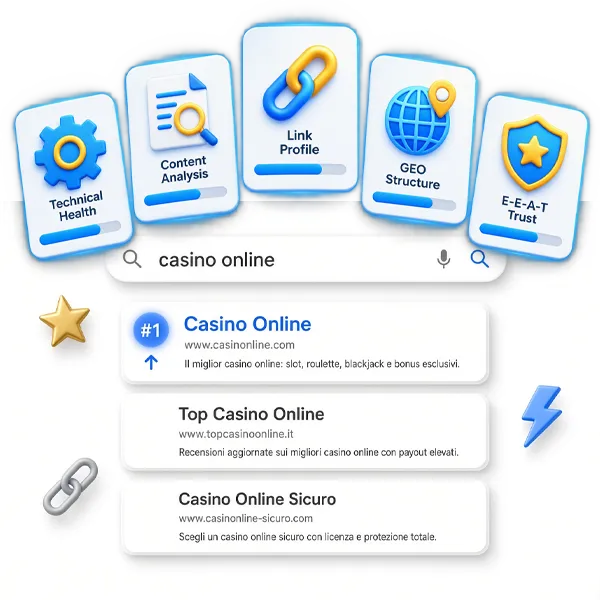
iGaming Linkbuilding
Link building for online casinos and betting sites: editorial placements, PR, and an anchor text strategy for each page, where relevance carries...
Learn more →
iGaming Brand Protection
Brand protection for casino and betting brands: detecting fake sites and misuse, monitoring, taking action, defending the brand on Google, and providing...
Learn more →
Protection of Branded Search Results
Protecting your branded search results: Ensure official pages are clearly at the top and players don't end up on clones or misleading...
Learn more →
Impersonation Monitoring
Monitoring of imitations targeting casino brands: detecting lookalike domains, cloned pages, and fake support channels, gathering evidence, and securing their removal.
Learn more →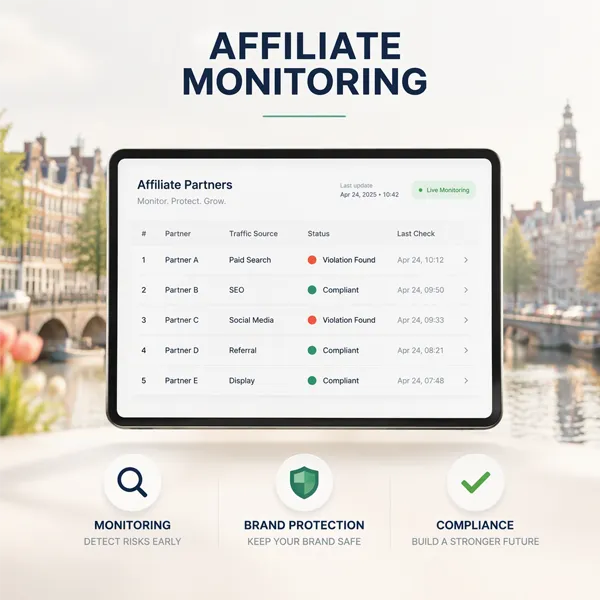
Affiliate Brand Monitoring
Affiliate brand monitoring for iGaming brands: checking partners' branded advertisements and pages for compliance with your guidelines, providing evidence and a clear...
Learn more →Welcome to NIWI
The iGaming market is growing at a 9.2% CAGR through 2027, and 78% of all player acquisition flows through organic search and affiliate channels. That makes iGaming technical SEO one of the most valuable investments an operator or affiliate can make. Our agency helps casino operators, sportsbook platforms, and affiliate sites dismantle the technical roadblocks standing between them and higher rankings - so every euro and dollar spent on content and link building actually delivers results in search engine positions.
+300
iGaming SEO projects completed
+12
years in casino and betting search
iGaming SEO
Casino Link Building
Sports Betting SEO
Multi-GEO Content
Let Google Read Your Site Before You Add Content
A lot of operators spend months building out content and acquiring backlinks without ever checking whether Google can actually index those pages. It is the digital equivalent of opening a brand-new casino while the front door is locked. Technical SEO is the key that unlocks that door - and without it, every penny invested in content and link building is effectively wasted on a site the search engine cannot properly read.

When our iGaming SEO specialists kick off a new project, we always start with a full technical audit. Not because it looks impressive in a report - but because it is the only reliable way to know which money pages are actually indexed, how the site performs under live-event traffic load, and where crawl budget is bleeding out to duplicate URLs and redirect chains nobody has noticed in months.
| 🔧 Technical Area | 📌 iGaming Problem | 🛠 Our Approach | 📈 Business Impact |
| 🕷 Crawling and Indexation | Orphaned pages, duplicate URL variants | robots.txt audit, sitemap restructuring | Money pages visible in Google |
| ⚡ Speed and Core Web Vitals | Heavy JS lobby builds, slow mobile load | LCP/INP/CLS optimisation under live load | Better rankings, higher conversion |
| 🌐 JavaScript Rendering | SPA casinos unreadable by Googlebot | SSR implementation, pre-render verification | Full indexation of player-facing pages |
| 🏗 International Architecture | Hreflang errors, misconfigured mirrors | Hreflang audit, geo-redirect logic | Stable rankings per region and language |
| 📐 Structured Data | Missing or broken schema markup | Schema implementation for iGaming content | Rich snippets, improved SERP CTR |
| 🔄 Safe Migrations | Organic traffic loss during rebranding | Redirect mapping, post-launch monitoring | No loss of built-up domain authority |
Common Technical Issues on Casino Sites
Anyone working in casino technical SEO knows that gambling platforms come with their own distinct category of technical problems - ones you will not find in standard SEO playbooks, and ones that agencies without deep iGaming experience routinely miss.
Here are the most frequent pain points our audit team encounters across operator and affiliate sites:
Heavy JavaScript lobby builds
the game lobby of a typical casino is loaded entirely in JS, which means Googlebot cannot read a single game title or thumbnail from the entire catalogue;
iGaming provider iframes
games from Pragmatic Play, Evolution Gaming, and Hacksaw Gaming are served inside iframes, making them completely invisible to crawlers;
Geo-redirects that block crawlers
redirect logic built to route players to their regional version sometimes sends Googlebot to an empty or access-blocked page instead;
Mirrors and language zones
casino sites running multiple language versions generate enormous volumes of duplicate content when hreflang is absent or misconfigured;
Duplicate URL variants from filters and pagination
slot catalogues with filtering systems produce hundreds of duplicate pages that eat into crawl budget and dilute indexation signals;
Slow mobile load times
in growth markets like LATAM and South and Southeast Asia, mobile speed directly determines conversion rates, yet casino sites consistently score poorly here.
Every one of these issues has a direct impact on search engine rankings. iGaming technical SEO is not a luxury add-on - it is the foundational layer on which every other part of your organic strategy is built.
Crawling and Indexation
The most persistent misconception among casino operators is that a well-stocked XML sitemap equals good indexation. It does not. Google does not automatically index everything listed in a sitemap - it crawls actively based on available crawl budget, the authority of each page, and how clearly the internal link structure signals where the most important content lives.

Our agency starts every technical SEO engagement with a simulated crawl in Screaming Frog and Netpeak Spider, followed by a detailed analysis of the server access.log covering a minimum of 30 to 90 days. That log tells us exactly which pages Googlebot visits, how often, and which it ignores entirely. From there, our iGaming SEO specialists systematically check:
the robots.txt for accidentally blocked directories - it is remarkable how often staging environments or bonus campaign pages are blocked from crawlers entirely; the XML sitemap for accuracy and freshness, including hreflang annotations for multilingual builds; canonical URL configuration to prevent filter and pagination variants from competing with the primary page for ranking signals; and HTTP status codes - the log surfaces 3xx chains, soft 404s, and 5xx errors that simply do not appear in a standard reporting dashboard.
For a casino platform running 20,000 or more URLs, this is not an afternoon task. The team cross-references Ahrefs and Google Search Console data against crawl findings to map exactly which indexation issues are costing the most organic traffic - so fixes are prioritised by real revenue impact, not just technical severity level.
Rendering and JavaScript
Virtually every modern casino site is built on React, Vue, or Angular. For the player, that is great - smooth animations, a dynamic lobby, fast navigation between sections. For casino technical SEO, it is a persistent challenge, because Googlebot struggles significantly more with JavaScript-rendered content than with clean, server-delivered HTML.
What does Googlebot actually see when it visits your homepage? That is the first question our casino SEO experts ask on any new engagement. We use the Google Search Console URL Inspection tool and third-party render testing services to map the gap between what a browser shows a human visitor and what a crawler actually receives. On SPA casinos - Single Page Applications - we regularly find that the entire game lobby is completely empty from Googlebot's perspective, that bonus pages serve no visible content because the copy loads through a secondary API call, and that navigation menus and internal links are entirely absent because they are rendered via JavaScript rather than present in the initial HTML response.

The fix is a combination of Server-Side Rendering for dynamic player-facing pages and pre-rendering for static content pages. This not only resolves indexation gaps but has a direct, measurable effect on Core Web Vitals performance - particularly Largest Contentful Paint, which is the Google ranking signal most directly tied to perceived page speed.
Speed and Core Web Vitals
Core Web Vitals are not abstract Google metrics gathering dust in a developer documentation tab somewhere. They are a confirmed ranking factor, and they have a demonstrable effect on the bounce rate of casino and sportsbook pages. When a player in Brazil or Nigeria is sitting on a mobile connection waiting four seconds for a bonus landing page to load, that player is gone. And so is the affiliate commission that player would have generated.
Our team benchmarks Core Web Vitals for clients under realistic traffic load scenarios - including high-peak moments like Champions League knockout fixtures, Club World Cup group stage matchdays, major cricket tournaments, and weekend football markets, when sportsbook platforms can absorb ten times their normal concurrent sessions within a matter of hours. The three metrics we monitor with particular attention are LCP (Largest Contentful Paint), targeting under 2.5 seconds for the largest visible element on screen; INP (Interaction to Next Paint), targeting under 200 milliseconds for responsiveness after a user interaction; and CLS (Cumulative Layout Shift), targeting under 0.1 to prevent visual instability while the page loads.
Typical improvements our agency implements include image compression and WebP conversion for game thumbnails across slot catalogues; elimination of render-blocking third-party scripts including live chat widgets and payment provider scripts from Visa, Mastercard, and Skrill; lazy loading for game grid layouts; and server response time optimisation with iGaming-specific hosting providers that are purpose-built for the unique traffic demands of gambling platforms.
In mobile-first markets - where 70% or more of platform traffic originates - iGaming technical SEO speed work is directly connected to revenue in both USD and EUR-denominated markets. Every second shaved from load time translates into a measurable uplift in player registrations and first deposits.
International Architecture
A casino or sportsbook platform operating across multiple markets faces one of the most architecturally complex challenges in technical SEO: how do you structure a multilingual, multi-jurisdictional site so that Google reliably serves the right page to the right user - without fragmenting ranking authority across dozens of competing variants?
Our agency has solved this structural problem for operators running simultaneous iGaming operations in Ontario (Canada), Malta (EU-jurisdiction), and multiple LATAM markets at the same time. There is no single correct answer - the right choice depends on domain authority, link profile strategy, and how many active language versions the platform needs to maintain simultaneously.
Subdirectories, Subdomains, or Separate Domains
Subdirectories - for example site.com/en/ or site.com/es/ - are the most widely recommended structure because all link authority consolidates at the root domain level. For platforms entering new markets where the domain already holds established authority, this is the first-choice recommendation from our iGaming SEO specialists.
Subdomains are sometimes used when the legal and compliance structure per market differs significantly enough to require separate CMS implementations. The downside is that Google treats subdomains as independent sites, which means authority building is slower than it would be under a subdirectory architecture.
Separate domains only make sense when an operator is intentionally building distinct brand identities per market, or when deploying SEO strategies where brand association across jurisdictions is commercially undesirable - typically in contexts involving geo targeting SEO for legally sensitive or heavily regulated markets.
Hreflang Without Errors
Hreflang is probably the most consistently misunderstood technical SEO implementation in iGaming - and the one most frequently broken in production. Common errors our audit team finds: hreflang annotations that are not reciprocal - page A points to B, but B does not point back to A; x-default annotations that are missing entirely or point to the wrong language version; and canonical tags that conflict with hreflang when a page canonicalises to a different URL while its hreflang annotation still references the original one.
We validate hreflang using Screaming Frog, Ahrefs, and manual checks inside Google Search Console. For platforms running hundreds of pages per language version, we build automated validation scripts that check hreflang integrity after every deployment - catching errors before Googlebot indexes the broken version and before ranking signals start fragmenting.
Mirrors and Geo-Redirects
Casino mirrors are a commercial reality in iGaming - especially for operators active in markets where the legal landscape can shift. But poorly configured mirrors cannibalise the rankings of the primary domain, fragment link authority, and make it impossible for Googlebot to read a consistent signal about which version of the site carries the actual authority.
Our team documents the full mirror architecture for each client, establishes which version serves as the canonical master, and configures geo-redirect logic so that human visitors receive the correct version while Googlebot consistently reads and credits the master. This kind of implementation requires precise, sustained collaboration with the development team - and that is exactly where our embedded working model makes the real difference between recommendations that get implemented and ones that sit in a backlog indefinitely.
Structured Data
Schema markup sits at a complicated intersection for iGaming content. Google permits casino-related rich snippets in a limited set of formats - and deploying schema for promotional content can trigger manual actions in Google Search Console if it is handled carelessly.
| 📋 Schema Type | ✅ Applicable for iGaming | 📌 Use Case | ⚠ Watch Point |
| Organization | Yes | Brand identity and contact details | No promotional claims |
| BreadcrumbList | Yes | Navigation structure for category pages | Correct hierarchy required |
| FAQPage | Yes | FAQ sections on bonus pages and informational content | Authentic Q&A pairs only |
| Article | Yes | News articles and player education content | Author information required for E-E-A-T |
| Review | Limited | Casino reviews authored by editorial staff | Not for user-generated ratings |
| Promotional schema | No | Not applicable for bonus offers | Leads directly to a Google penalty |
Spribe Aviator content and crash game pages fall within the Article and FAQPage schema types. For Evolution Gaming live casino content, we typically deploy BreadcrumbList structure alongside comprehensive FAQ sections covering game rules and format details - a combination that pairs well with informational search intent and strengthens the E-E-A-T signals Google is weighting more heavily for iGaming content across the board. AI in SEO tooling is increasingly used to validate schema implementations at scale and surface inconsistencies before they ever reach production.
Safe Migrations
A domain migration, CMS switch, or complete platform redesign is one of the most operationally high-risk events in casino technical SEO. We see the same story too often: an operator launches a new site and watches 40% to 70% of their organic traffic disappear over the following weeks. Not because the new site is poorly built - but because the migration was not properly planned, mapped, and monitored.
Our agency manages migrations across three distinct phases. Before launch, we build a comprehensive redirect map ensuring every existing URL has a 301 redirect pointing to the most topically relevant page on the new site. We test the migration in a staging environment and simulate exactly what Googlebot will encounter when it discovers the new structure for the first time. After launch, we monitor crawl data daily inside Google Search Console, Ahrefs, and Screaming Frog - watching for redirect chains, 404 errors, and unexpected drops in indexed URL counts.
For platforms running thousands of pages and mirrors - think about an operator with separate versions for football markets, cricket betting sections, and payment-specific landing pages for Neteller, Skrill, and cryptocurrency deposits - migration complexity scales exponentially. For those engagements, we build prioritised redirect lists that verify money pages first, with our casino SEO experts providing daily status updates until crawl data stabilises and rankings return to their pre-migration baseline.

Working With Your Developers
Technical SEO stays theoretical until someone actually implements it. And implementation requires a functional working relationship with the client's development team. That sounds obvious - but in practice, the gap between SEO recommendations and actual deployment is one of the biggest recurring bottlenecks in iGaming projects at every scale and budget level.
Our team does not deliver loose PDF reports that disappear into a shared folder and get opened twice. We work with prioritised tickets in whatever format the development team already uses - Jira, Linear, or a shared spreadsheet - including a clear description of the issue, the estimated ranking impact, a technical specification of the fix, and a verification protocol so we can confirm after implementation that the change actually landed as intended and not just as a checkbox on a ticket.
We hold fixed technical check-ins per sprint cycle - typically biweekly - where we work through progress with developers and resolve any implementation friction in real time. That rhythm is what ensures iGaming technical SEO improvements do not sit on a backlog for months as perpetually open tickets, but ship within realistic timelines on a cadence the business can rely on and plan around.
Post-Audit Monitoring
A one-time technical audit is a snapshot. Casino platforms are dynamic environments: new player pages go live, bonus campaigns rotate, CMS updates introduce new technical problems. What was correctly configured last month can be silently broken next month without triggering any visible alert in your reporting tools.
Free strategic SEO analysis?
This iGaming SEO agency provides structured ongoing monitoring as part of every active SEO engagement. That includes weekly automated crawls via Screaming Frog cloud crawler with alerts on new 4xx errors, redirect chain issues, or unexpected drops in indexed URL counts; monthly technical reporting with Core Web Vitals trends, crawl statistics from Google Search Console, and period-on-period comparison data; real-time Core Web Vitals monitoring for money pages including bonus landing pages and payment pages for Visa, Mastercard, and cryptocurrency deposits; and priority escalation for urgent issues - a sudden ranking drop or indexation failure is handled on the same business day, not in the next monthly report cycle.
Transparency is a core value of how we operate. You always have access to live dashboards covering rankings, indexed pages, organic traffic, and conversion metrics - which makes the ROI of casino technical SEO improvements directly visible in the numbers rather than something you are asked to take on faith.
Casino technical SEO and iGaming technical SEO are not standalone services for us - they are ongoing responsibilities. The iGaming industry never stops moving, and neither does our monitoring.
The iGaming market rewards operators and affiliates who build consistently and methodically. No sprints, no shortcuts that return as a penalty three core updates later. What holds its ground is a platform with a technically sound architecture, content that hits the right search intent, and a link profile that contributes genuine topical authority. That is what our iGaming SEO agency builds - project after project, market after market.
Ready to Grow with iGaming SEO
Technical SEO is the foundation that makes every other SEO investment pay off. Content that is not indexed generates no traffic. Links pointing to pages Googlebot cannot read do not build authority. And a casino platform that takes four seconds to load on mobile does not convert - no matter how well the bonus page is structured or how compellingly it is written.
Reach out through the contact form on the site. The team responds within 2 to 6 business hours and schedules a video intake call when the project scope warrants it. We work Monday to Friday, 09:00 to 18:00 GMT, and treat urgent issues like ranking drops and indexation failures as same-day priorities.
FAQ
Frequently Asked Questions
A full technical audit is recommended at the start of any SEO engagement and at a minimum every quarter for active platforms. For casino sites with regular content updates and multiple language versions, we advise combining monthly automated crawls with a thorough manual review each quarter. For migrations or CMS upgrades, an immediate audit is always necessary to protect rankings.
Our team has hands-on experience with every major CMS and custom-built casino platform stack, including WordPress-based affiliate sites, proprietary sportsbook backends, and hybrid headless CMS setups. We adapt our technical recommendations to what your platform can actually support and work closely with your developers to make implementation achievable within your technical infrastructure and project timelines.
We provide detailed technical specifications that your developers can implement directly. On request, we can deliver the code itself for specific components - structured data, robots.txt adjustments, sitemap configuration. For actual deployment into the CMS or hosting environment, we work alongside the client's internal team, which keeps the right level of control and quality assurance on their side of the process.
Yes - migration management is one of our core services. We handle domain migrations, CMS transitions, and full site redesigns from beginning to end: redirect mapping, pre-launch testing, and daily monitoring for the weeks following launch. For large platforms with thousands of URLs, we build a detailed migration protocol that minimises the risk of ranking loss and keeps every stakeholder informed throughout the process.
We offer a free preliminary site analysis delivered within 24 to 72 hours of first contact. You will receive a breakdown of the most critical technical issues on your platform, an initial estimate of the impact those issues are having on rankings and organic traffic, and a concrete prioritisation of the first fixes worth making. No sales pitch - just an honest read on where your platform stands and what the first steps look like toward stronger, more sustainable search engine performance.